
Waste Becomes Valuable
When Someone Has a Reason to Buy It.
The metals industry proved this model more than 150 years ago: when scrap has value, it moves back into manufacturing
through a profitable circular supply chain.
Steel proved the model. Now we’re applying it to wood.
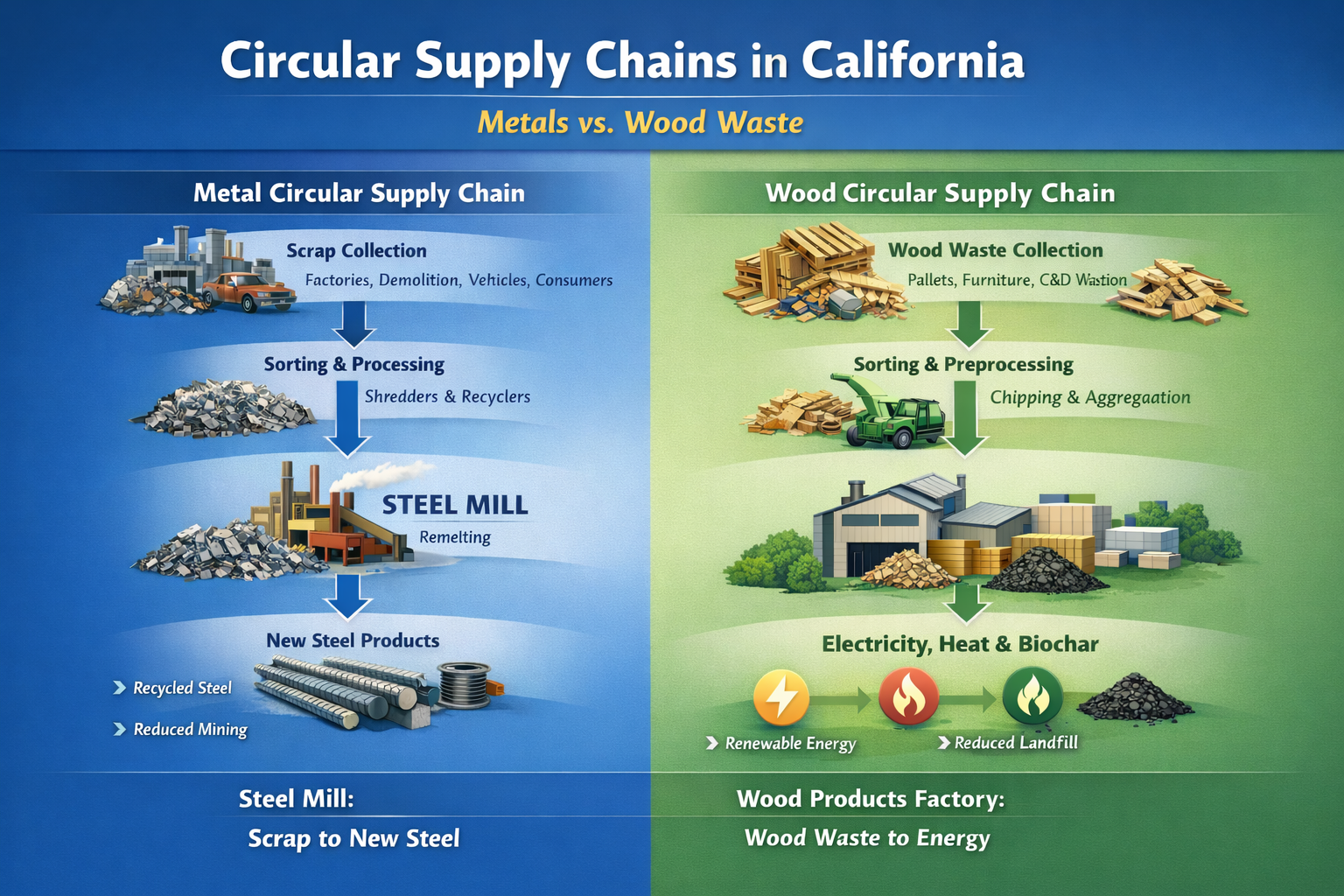
THERE’S CASH IN THAT TRASH!
Woodworking manufacturers generate enormous quantities of wood waste. Instead of asking, “How do we get rid of it?” ask:
“What can we make with it?”
Turn a disposal cost into an asset.
ONE WASTE STREAM. MULTIPLE BENEFITS.
WOOD WASTE -> ADVANCED BIOMASS / PYROLYSIS
ELECTRICITY
Lower purchased power costs.
BIOCHAR
Commercial product: roughly
$200-$1,300/ton depending on grade, volume
and market.
AVOIDED DISPOSAL COSTS
Reduce hauling and disposal expense.
CARBON REMOVAL CREDITS
Potential additional revenue: roughly
$100-$300 per metric ton CO2e.
HEAT
Useful thermal energy.
RENEWABLE FUELS & HYDROGEN
Potential additional energy products.
ADVANCED CARBON MATERIALS
Potential high-value uses in batteries, composites and advanced manufacturing. Industrial graphene nanoplatelets can command thousands to tens of thousands of dollars per ton depending on grade and processing.
LOWER COSTS + NEW REVENUE + LESS WASTE
Turn the Waste Into Power Where It Is Created
For manufacturers, one of the most promising applications is simple: use factory wood waste to help power the factory
REDUCE ELECTRICITY COSTS
Offset power otherwise purchased from the utility.
REDUCE DISPOSAL COSTS
Avoid paying to haul an energy feedstock away.
REDUCE TRUCK TRIPS
Keep material onsite instead of sending load after load to disposal.
REDUCE GRID DEMAND
Behind-the-meter generation can take demand off the grid.
PROTECT MANUFACTURING JOBS
Lower operating costs can make manufacturing more competitive.
Why are we using scarce diesel to haul an energy feedstock to disposal?
WHAT ABOUT AIR QUALITY?
Technology has changed. Modern systems can use advanced thermal conversion and emissions-control technologies very different from traditional open burning or simple combustion.
Supply Chains for Good is working with manufacturers, technology providers and regulators to determine which systems can safely process manufactured wood waste while meeting stringent air-quality requirements.
Let the technology prove itself.
CIRCULARITY MUST MAKE ECONOMIC SENSE
Environmental benefits matter. But manufacturers cannot invest millions simply because something is environmentally desirable. The investment also has to make economic sense.
Profit isn’t the enemy of circularity. It is what allows circularity to scale.
Profits pay wages. Buy equipment.
Fund expansion. Protect jobs.
THE WOODWORKING INDUSTRY HAS DONE THIS BEFORE
Particleboard and MDF demonstrate profit-driven circularity: manufacturers found economic uses for wood residuals and turned them into useful products. The next challenge is manufactured wood waste that does not yet have a strong market. Advanced biomass can help create one.
WHAT IF YOUR WASTE COULD HELP POWER YOUR FACTORY?
Supply Chains for Good works with manufacturers, technology providers, regulators, researchers, and industry partners to build circular supply chains that work economically and environmentally.